Solar eclipse · 9 May 2032

Annular solar eclipse of 9 May 2032

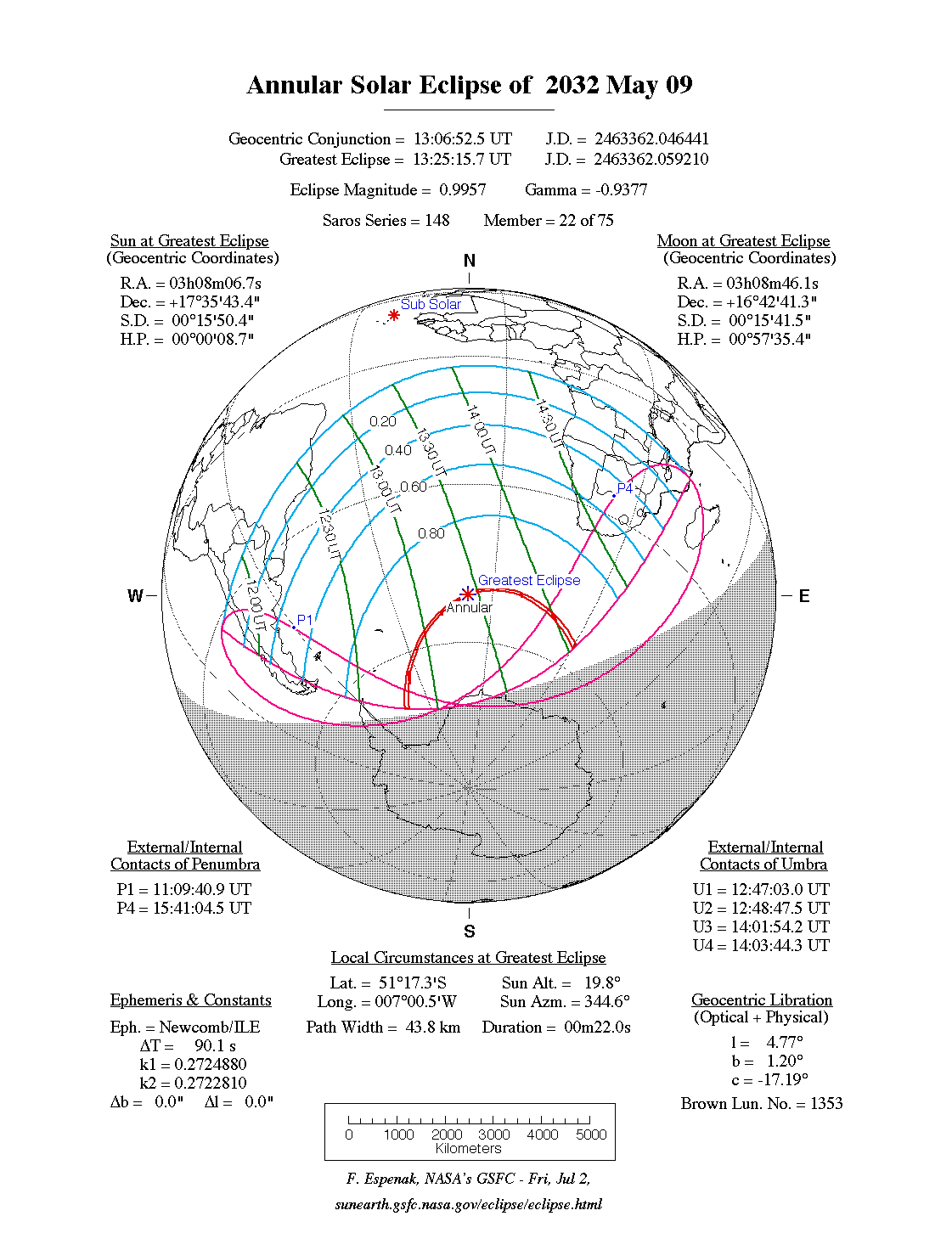
On 9 May 2032 the path of annularity crosses the South Atlantic, and a partial eclipse is visible from southern South America and southern Africa. At greatest eclipse, at 13:25 UTC, annularity lasts 22 s on the central line.

Starts in--until it begins somewhere on Earth

Key facts

Type
Annular solar eclipse
Greatest eclipse
13:25:24 UTCat 51.3° S, 7.1° W
Longest annularity
43 son the central line at 55.7° S, 30.6° E
Magnitude
0.9957Moon/Sun diameter ratio at greatest eclipse
Begins (P1)
11:09 UTCfirst contact anywhere on Earth
Ends (P4)
15:41 UTClast contact anywhere on Earth
Visible from
Southern South America and southern Africa
Path of annularity
the South Atlantic

Saros 148, eclipse 22/75. Computed by our engine from NASA’s Besselian elements: NASA GSFC.

The Moon’s shadow, minute by minute

The band is the path of annularity; the lighter area is where the partial eclipse is visible at that moment, and the darkest one is night. Click the map to choose a place.

The Moon’s shadow on the map

Loading the map…

  • Path of annularity
  • Centre line
  • Annularity now
  • Partial eclipse now
  • Night
  • Chosen place

Chosen place: Cape Town. See the times

Your sky during the eclipse

What you will see from Cape Town. Move the time slider and watch the Moon slide across the Sun.

The Sun and the Moon

Start15:05End17:36Maximum16:25Up
Close-up, facing the Sun: up is up in your sky. The dashed line is the Moon’s path, from the first bite to the last.

The Moon covers 63.5% of the Sun. Keep your eclipse glasses on.

Sun covered:63.5%

Where to look

Look northwest, 16° up - about a third of the way from the horizon to overhead.

30°WWNWNWNNWNStartEnd
The Sun’s path from the start to the end of the eclipse, with a mark every 30 minutes. The small Sun is drawn larger than life.

Your town

Search for any town in the world or use your location to get local times to the second.

Towns and cities of over 15,000 people, worldwide.

Annular solar eclipse, 9 May 2032 - Cape Town: partial, 63.5% of the Sun covered

Example

Cape Town

Western Cape, South Africa

Local time in Cape Town (UTC+2)

Cape Town is an example in the path of annularity. Search for your own town to see your times.

Partial eclipse: the Moon covers up to 63.5% of the Sun

Magnitude
0.710
Sun’s area covered
63.5%
Sun at maximum
16° high in the northwest
Eclipse times at this place
EventLocal timeUTCSun altitude
Partial eclipse begins15:05:1513:05:1528°
Maximum eclipse16:25:3514:25:3516°
Partial eclipse ends17:36:1315:36:133°

Nearest annularity

The nearest place with annularity is 1,891 km to the south. Right at the edge, annularity lasts about 6 s; closer to the centre line it lasts longer.

Times are accurate to a few seconds. Contact times are rounded to the second. How we calculate
Towns in the path

Large towns where the eclipse can be seen. Choose one to see it in the tool above.

Towns where the eclipse of 9 May 2032 is visible, central phase first
TownWhat you seeMaximum (UTC)
Cape TownSouth Africa63% covered14:25
GqeberhaSouth Africa59% covered14:32
BloemfonteinSouth Africa45% covered14:38
DurbanSouth Africa43% covered14:41
JohannesburgSouth Africa36% covered14:43
MaputoMozambique32% covered14:46
Mar del PlataArgentina25% covered12:07
BulawayoZimbabwe20% covered14:49
MontevideoUruguay19% covered12:07
LubangoAngola17% covered14:38
Buenos AiresArgentina17% covered12:05
BeiraMozambique15% covered14:52
Porto AlegreBrazil14% covered12:12
HarareZimbabwe13% covered14:52
BenguelaAngola12% covered14:39
FlorianópolisBrazil11% covered12:16
HuamboAngola11% covered14:42
RosarioArgentina11% covered12:02

Watch it safely

At annularity a ring of the Sun stays uncovered, and it is as dangerous to look at as the full Sun. Wear eclipse glasses (ISO 12312-2) for the whole eclipse, from the first contact to the last.

How to watch safely

Sources

  1. NASA GSFC - Annular solar eclipse, 2032-05-09: Besselian elements
  2. NASA GSFC - Annular solar eclipse, 2032-05-09: path table
  3. NASA GSFC - Annular solar eclipse, 2032-05-09: global map