Solar eclipse · 23 September 2033

Partial solar eclipse of 23 September 2033

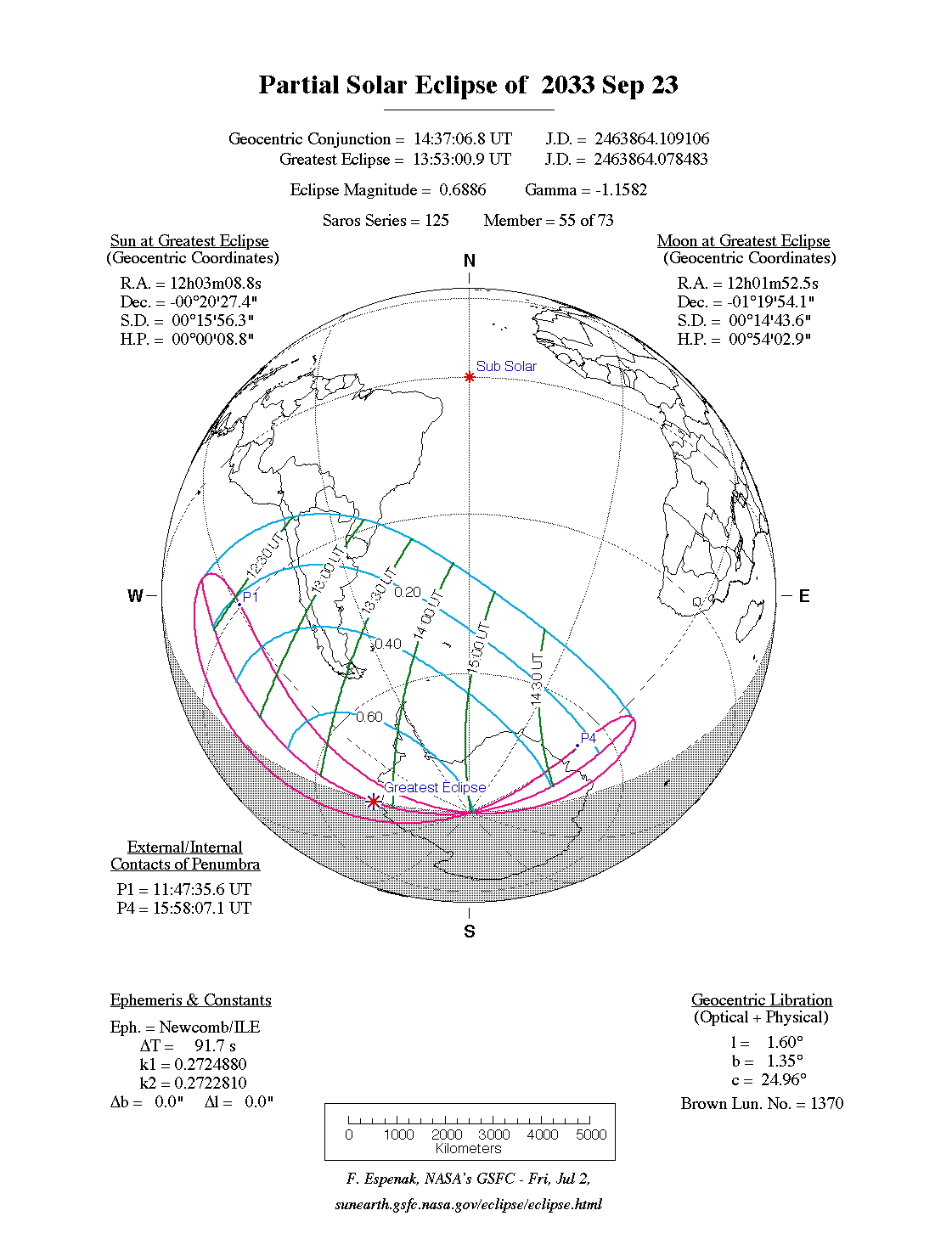
On 23 September 2033 the Moon’s shadow passes beside the Earth, so nowhere sees the Sun fully covered. A partial eclipse is visible from southern South America and Antarctica; at its greatest, at 13:53 UTC, the Moon covers 69% of the Sun’s diameter.

Starts in--until it begins somewhere on Earth

Key facts

Type
Partial solar eclipse
Greatest eclipse
13:53:12 UTCat 72.3° S, 121.3° W
At its greatest
69% of the Sun’s diameter covered
Magnitude
0.6890fraction of the Sun’s diameter covered at greatest eclipse
Begins (P1)
11:47 UTCfirst contact anywhere on Earth
Ends (P4)
15:58 UTClast contact anywhere on Earth
Visible from
Southern South America and Antarctica

Saros 125, eclipse 55/73. Computed by our engine from NASA’s Besselian elements: NASA GSFC.

The Moon’s shadow, minute by minute

Nowhere sees the Sun fully covered this time: the lighter area is where the partial eclipse is visible at that moment, the darkest one is night. Click the map to choose a place.

The Moon’s shadow on the map

Loading the map…

  • Partial eclipse now
  • Night
  • Chosen place

Chosen place: Bahía Blanca. See the times

Your sky during the eclipse

What you will see from Bahía Blanca. Move the time slider and watch the Moon slide across the Sun.

The Sun and the Moon

Start09:09End11:14Maximum10:09Up
Close-up, facing the Sun: up is up in your sky. The dashed line is the Moon’s path, from the first bite to the last.

The Moon covers 15.6% of the Sun. Keep your eclipse glasses on.

Sun covered:15.6%

Where to look

Look east-northeast, 35° up - a bit less than halfway between the horizon and overhead.

30°NNNENEENEEStartEnd
The Sun’s path from the start to the end of the eclipse, with a mark every 30 minutes. The small Sun is drawn larger than life.

Your town

Search for any town in the world or use your location to get local times to the second.

Towns and cities of over 15,000 people, worldwide.

Partial solar eclipse, 23 September 2033 - Bahía Blanca: partial, 15.6% of the Sun covered

Example

Bahía Blanca

Buenos Aires, Argentina

Local time in Bahía Blanca (UTC-3)

Bahía Blanca is an example where this partial eclipse is deep. Search for your own town to see your times.

Partial eclipse: the Moon covers up to 15.6% of the Sun

Magnitude
0.267
Sun’s area covered
15.6%
Sun at maximum
35° high in the east-northeast
Eclipse times at this place
EventLocal timeUTCSun altitude
Partial eclipse begins09:09:2712:09:2725°
Maximum eclipse10:09:1413:09:1435°
Partial eclipse ends11:14:3314:14:3344°

Times are accurate to a few seconds. Contact times are rounded to the second. How we calculate
Towns with the deepest eclipse

Large towns where the eclipse can be seen. Choose one to see it in the tool above.

Towns where the eclipse of 23 September 2033 is visible, central phase first
TownWhat you seeMaximum (UTC)
SantiagoChile13% covered12:49
Mar del PlataArgentina12% covered13:13

Watch it safely

The Sun is never completely covered: wear eclipse glasses (ISO 12312-2) for the whole eclipse.

How to watch safely

Sources

  1. NASA GSFC - Partial solar eclipse, 2033-09-23: Besselian elements
  2. NASA GSFC - Partial solar eclipse, 2033-09-23: global map